



Compare constant heat-sealing and closed-loop impulse welding to discover key differences in thermal dynamics, energy efficiency, and process validation.
AI This article was created with the help of AI.
Understanding the Physics: How Thermal Sealing Methods Transfer Heat
Thermoplastic joining relies on a simple thermodynamic principle: transferring sufficient thermal energy to mating polymer layers under mechanical pressure to disrupt their molecular structures and allow them to fuse. When pressure is applied, heat must migrate through the film layers to reach the sealing interface. Constant heat-sealing achieves this by maintaining continuously heated bars that remain hot throughout operation, transferring heat steadily through the material stack. In contrast, impulse welding joins thermoplastics with a short electrical heat impulse, controlled in milliseconds. Understanding this heat path is essential for optimizing seal integrity.
If we trace the thermodynamic path, the heat path in impulse welding originates from the outside of the material stack and flows inward to the core interface, warming the outer film layers along the way. While other advanced joining methods like ultrasonic welding keep outer layers cooler by generating heat directly at the interface via friction, thermal contact methods rely on conduction. Because thermal energy must penetrate the outer layers first, precise thermal management is critical to prevent degradation of the external film surface. A controlled heating profile ensures that the interface reaches the necessary melting point without overheating the outer containment layers. This thermal control directly affects the repeatability of the finished seal.
- Constant heat transfers thermal energy continuously, requiring steady standby power even when idle.
- Impulse systems generate thermal energy on demand, applying heat only during the active welding cycle.
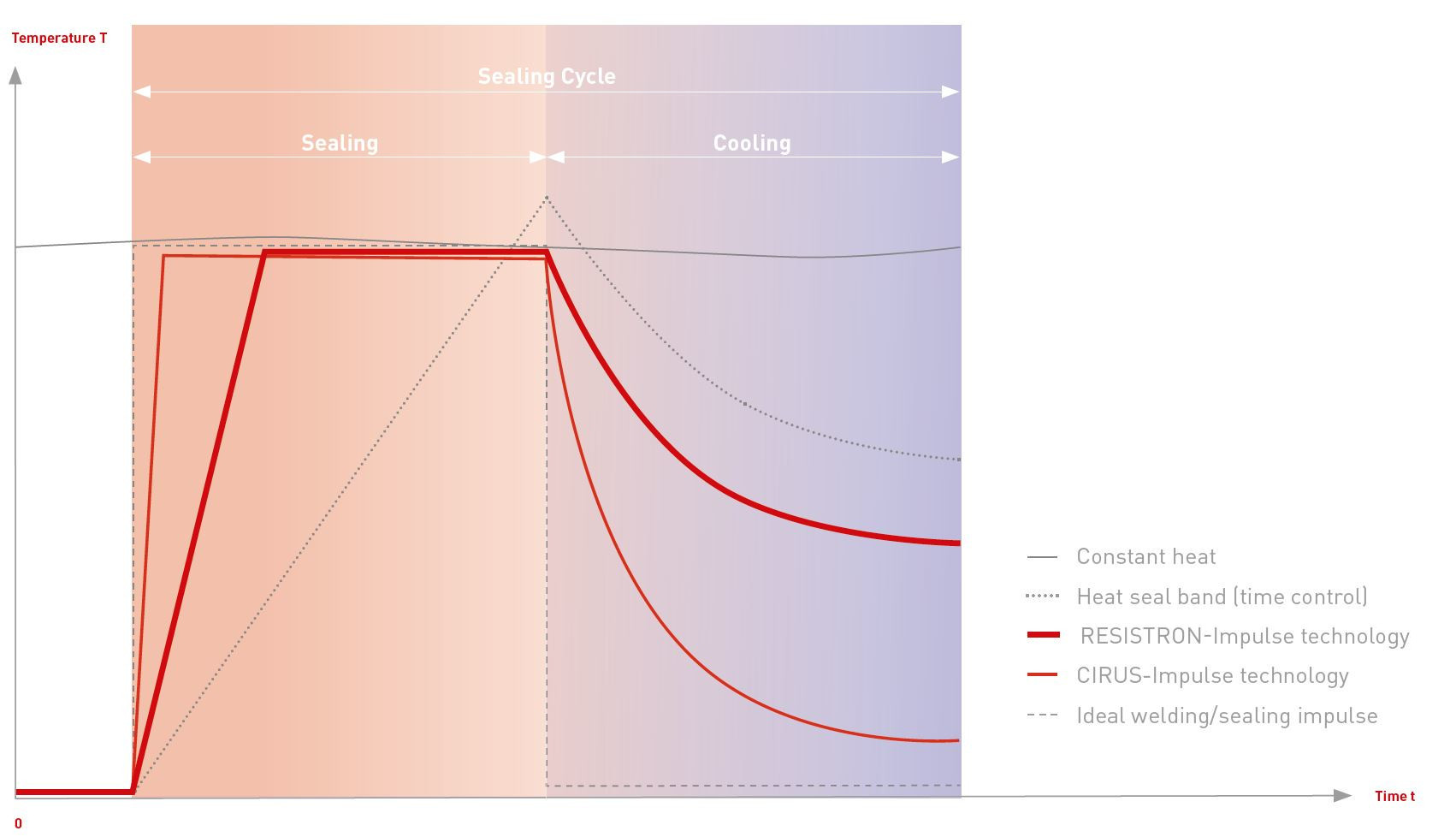
- During impulse welding, the heat-sealing element cools down while active contact pressure is applied, thereby stabilizing the molecular bond before release.
- Constant heat systems lack dynamic cooling, meaning the seal remains hot and vulnerable immediately after the jaws open.
For packaging engineers managing sensitive processes, controlling these thermodynamic forces is the difference between consistent quality and high scrap rates. While constant-heat methods offer simplicity for low-demand applications, they are prone to thermal drift as ambient conditions change. Transitioning to a precise impulse sealing process allows for dynamic control over the sealing parameters of temperature, time, and pressure. Furthermore, implementing modern temperature-based control instead of simple timer-based impulses provides the real-time feedback loop necessary to establish a highly repeatable, validatable sealing process.
The Thermal Lifecycle: Constant Heat vs. Impulse Dynamics
In thermoplastic packaging, managing heat transmission precisely is essential for establishing robust process control. To build a reliable workflow, process technicians often analyze impulse sealing alongside traditional methods. Impulse welding joins thermoplastics with a short electrical heat impulse, controlled in milliseconds, ensuring that energy is applied only during the active sealing phase[1]. In contrast, constant heat-sealing permanently heats the sealing jaws, which requires a preheating time of about 15 minutes to reach the set temperature and maintains a continuous thermal load throughout the entire production cycle[2]. This thermodynamic difference directly affects energy consumption, thermal stress, and overall seal quality.
When working with packaging engineers in food and pharmaceutical manufacturing, we recognize that constant thermal load is a primary driver of process instability. When jaws remain hot during idle times, heat radiates into the surrounding machine structure, leading to thermal expansion and jaw misalignment. This heat accumulation causes temperature drift between cycles, meaning that the first packages processed after a line stoppage absorb excess heat, which often leads to burn-through. In contrast, the impulse cycle starts cold, meaning there is no warm-up phase, and energy is consumed strictly on demand[1]. The rapid cooling phase that follows immediately after the heating impulse allows the polymer chains to recrystallize under pressure, ensuring a secure molecular bond before the jaws open.
- Zero standby energy consumption during production idle periods because heat is generated only on demand
- Absence of ambient heat radiation, protecting nearby heat-sensitive products and reducing mechanical thermal stress
- Immediate start of production without waiting for the 15-minute jaw preheating phase
- Controlled cooling phase under jaw pressure to ensure high seal strength and eliminate polymer stretching
The Critical Cooling Phase and Seal Integrity
In our experience with high-precision thermoplastic packaging, the ultimate mechanical strength of a seam is determined not during the heating phase, but during the subsequent cooling cycle. When thermoplastic films reach their respective melting points, the polymer chains become highly mobile, sliding past one another under mechanical pressure. If the sealing jaws open while the material is still in this molten state, the lack of structural support can cause immediate joint failure. Under the influence of web tension, product weight, or rapid handling, molten polymers are highly susceptible to peeling, warping, or severe cosmetic seal distortion, undermining the integrity of the barrier.
- Solidification of the polymer under active mechanical holding force to prevent seam separation
- Complete recrystallization of the sealant layer before the sealing jaw pressure is released
- Successful mitigation of seal creep and peeling on delicate multi-layer composite structures
- Reduction of cosmetic defects and shrinkage, resulting in a clean and visually consistent seam
This physical vulnerability highlights the fundamental operational difference between constant heat-sealing and impulse welding. Constant heat sealers maintain a continuously heated bar, meaning they must release the film stack while the polymer is still hot and molten. This process requires exceptional hot tack characteristics from the film, which severely limits material selection and often results in high scrap rates due to thermal drift. Conversely, closed-loop impulse welding generates thermal energy only when needed, executing a dynamic heating cycle and then actively cooling the plastic while the jaws remain closed. Securing the joint under pressure until the polymer fully cures is the only reliable method to achieve repeatable, validatable seals. For a deeper technical evaluation of this process, engineers can explore the basics of impulse sealing.
Operational Efficiency: Energy Consumption and Material Waste
In high-throughput industrial packaging, overall equipment efficiency is closely tied to thermal stability and energy consumption. Through our engineering evaluations, we observe that constant heat-sealing systems maintain heated sealing bars at high temperatures continuously, even during production standbys or idle periods. This constant thermal load results in significant standby energy consumption and introduces a critical thermodynamic issue: thermal drift. Because the sealing jaws are permanently hot, heat radiates throughout the surrounding machinery, altering the baseline temperature of the sealing environment over time. This thermal instability can require regular operator adjustments and recalibration, which leads to substantial start-up material waste and scrap during validation runs.
In contrast, closed-loop impulse welding operates on a highly dynamic thermal profile. Electrical power is drawn exclusively during the active sealing window, which typically lasts only milliseconds. The heat-sealing element remains cold until current is applied and cools rapidly immediately after the weld is completed. This demand-driven cycle eliminates standby energy losses completely and resolves the issue of start-up scrap. For packaging engineers, this means the first bag is saleable immediately upon machine start, with zero warm-up period required. Understanding the basics of impulse sealing is essential to optimizing production throughput and reducing material waste.
- Elimination of the typical 5 to 15 minute preheating cycle, enabling instant start-up.
- Significant reduction in overall carbon footprint and utility costs due to zero standby power draw.
- Eradication of thermal degradation in delicate substrates by restricting heat application strictly to the seal window.
- Consistent seal quality from the very first cycle, reducing calibration-related material scrap.
The Validation Challenge in Regulated Manufacturing
Process validation in highly regulated packaging sectors, such as medical device manufacturing, demands absolute repeatability. Under strict industry standards like ISO 11607, manufacturers must demonstrate that their sealing process remains within a tight, validated operating window. This requirement presents a significant obstacle for conventional constant heat-sealing. Because constant heat systems run continuously, thermal energy naturally accumulates in the sealing jaws during high-volume runs. This thermal drift between cycles leads to variable heat transfer, causing seal quality to fluctuate and making it exceptionally difficult to validate the process reliably. Shifting from simple timers to temperature-based control is essential to eliminate these variable dynamics.
To address these stringent validation requirements, we position our technology as a critical enabler of a validatable process. Rather than relying on static heating, transitioning to impulse sealing allows packaging engineers to maintain exact control over the three core process variables: temperature, time, and pressure. Furthermore, our ROPEX Validation & Verification Tools provide the precise calibration and temperature validation required to assist quality managers in documenting compliance.
- Precise, millisecond-range control to eliminate thermal drift between cycles
- Highly repeatable sealing profiles that maintain consistent physical seal strength
- Real-time data output for comprehensive process validation and audit trails
- Simplified calibration procedures using specialized ROPEX Validation & Verification Tools
By controlling the entire thermal profile dynamically, generating heat only during the active welding phase and cooling the seal under pressure, we help engineers establish a stable, repeatable production line. This level of process control ensures that every cycle matches the validated baseline exactly, preventing startup material waste and protecting the integrity of critical packaging barriers.
Achieving Precision: Sensorless Temperature Control
While constant heat-sealing offers simplicity for low-demand applications, it suffers from thermal drift and lack of real-time control. In contrast, impulse welding delivers the millisecond-level dynamic thermal control required to achieve repeatable, validatable seals with zero standby energy. Unlike systems that remain hot continuously, impulse sealing generates heat only during the active welding phase, eliminating the constant energy draw and material distortion associated with permanent heat sources.
To manage this rapid heating and cooling cycle with high precision, we rely on ROPEX Temperature Controllers as the heart of our sealing technology. Instead of using fragile external thermocouples, our system uses sensorless temperature control. The electrical resistance of the heat-sealing element changes predictably with temperature. By measuring current and voltage 50 or 60 times per second, the controller tracks resistance in real time, meaning the heat-sealing element itself acts as the temperature sensor. This allows packaging engineers to establish a highly reliable temperature-based control loop.
- Eliminates external thermocouples that can fail or drift over time
- Maintains a consistent thermal profile cycle after cycle, regardless of ambient temperature changes
- Supports process validation by providing closed-loop control over temperature, time, and pressure
- Minimizes start-up material waste because there is no warm-up phase required before the first seal
For packaging engineers in regulated sectors like pharmaceuticals or medical devices, maintaining control over the sealing interface is essential. While we do not claim that our equipment independently complies with regulatory standards like ISO 11607, this precise feedback loop is a key helper for manufacturers looking to build a validatable process. By removing variables like ambient temperature drift and heater wear, we help our partners achieve consistent, repeatable packaging quality.
Selecting the Right Technology: RESISTRON and CIRUS Applications
Selecting the optimal joining technology requires a precise evaluation of seal geometry, production throughput, and material behavior. To help packaging partners build a validatable process that supports compliance with stringent quality requirements, we offer two distinct impulse-welding pathways: the RESISTRON and CIRUS systems. While both leverage sensorless temperature control, their physical construction and thermal dynamics are tailored to different production challenges.
For applications demanding long seals, complex 3D contours, or heavy-gauge materials, the RESISTRON system is the standard selection. Operating at rates up to 80 cycles per minute, our RESISTRON tools utilize flexible metal heat-sealing elements to deliver reliable thermal profiles across seal lengths up to 7 meters. This makes the system ideal for sealing medical pouches, spouts, and large-format industrial packaging where layer transitions require an adaptable heating conductor. However, because these heat-sealing elements and associated PTFE cover strips are subjected to thermal and mechanical stress, they function as wearable consumables that require periodic replacement during routine maintenance.
- RESISTRON for seal lengths up to 7 meters and complex 3D contour geometries
- CIRUS for high-speed dynamic sealing at rates up to 120 cycles per minute
- Millisecond-range sensorless temperature control for a repeatable, validatable process
Conversely, the ceramic-based CIRUS ULTRA-PULSE system is designed for high-speed, highly dynamic packaging applications, achieving cycle rates up to 120 cycles per minute. By utilizing advanced ceramic substrates in our CIRUS tools, the system minimizes thermal inertia to enable rapid heat-up and cool-down phases. Because the system requires an active cooling-water circuit, cleanroom suitability remains strictly application-dependent, as some facility operators restrict liquid cooling loops. Like RESISTRON, the CIRUS system relies on PTFE cover tapes as wearable consumables that undergo gradual degradation. Working closely with our partners, we assist in selecting the ideal technology and optimizing thermal profiles to secure long-term process reliability.
Frequently asked questions
What is the primary difference between constant heat-sealing and impulse welding?
Constant heat sealing maintains a continuously heated bar at a set temperature, while impulse welding applies a short electrical impulse to heat the heat-sealing element only during the weld cycle, cooling down immediately after.
Why does impulse welding provide better seal integrity for delicate materials?
Impulse welding holds the film under pressure during both the heating and cooling phases. Cooling the polymer under active pressure ensures the molecular chains align properly before release, preventing seal peeling or warping.
How does constant heat-sealing impact energy efficiency?
Because constant heat sealers must keep their sealing jaws at high operating temperatures throughout production and standby times, they consume energy continuously. Impulse systems draw electricity only during the brief heating impulse.
Is a warm-up period required for impulse sealing systems?
No. Impulse welding systems do not require a warm-up period because the low-mass heating element reaches operating temperature within milliseconds. This allows immediate production with zero start-up material waste.
How does sensorless temperature control improve the sealing process?
Sensorless temperature control monitors the electrical resistance of the heating element itself at 50 or 60 Hz. This eliminates external thermocouples, providing real-time, feedback for highly repeatable and validatable thermal profiles.
What are the limitations of constant heat-sealing?
Constant heat sealing lacks active, millisecond-level temperature regulation, leading to thermal drift between cycles. It also requires a 15-minute warm-up, wastes material during start-up, and continuously radiates heat into the workspace.